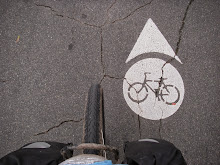
"The economics of promoting American liberties"
Quick - Name one thing proven to reduce personal and governmental costs of
transportation, reduce wear and tear on city streets, reduce traffic congestion,
improve air and water quality while boosting public health and well-being, that
makes economic sense for both personal budgets and city governments, all the
while being an expression of our fundamental American liberties?
Bicycling.
Bicycling is a fundamental expression of our American freedom to travel,
affirmed in the rights and immunities clause of the constitution. Americans
have the widely affirmed right in this country to travel by foot, on bike, on
horse or by public conveyance without needing a license to do so.
That's why you don't need a license to enter Washington after a weekend in
Portland, or to take a walk with your kids for some ice cream.
Every state in the union, however, does require operators of vehicles posing
a grave danger to public safety and damaging to public roads be licensed, their
vehicles licensed to collect payments for road upkeep, and the operators
insured.
This has been affirmed by the supreme court in several cases, Hendricks V
Maryland 1915 was one of the first, and in 1927 ruled in Hess V Pawloski that
" Motor vehicles are dangerous machines, and even when skillfully and carefully
operated, their use is attended by serious dangers to persons and property. In
the public interest the state may make and enforce regulations reasonably
calculated to promote care on the part of all..."
Motorists and cars are dangerous, very damaging and pose a financial burden on
states. Motorists and motor vehicles can be licensed for reasons affirmed by
the US Supreme Court. Not so for bicyclists.
Improving public safety and public health go hand and hand with
promoting bicycling. Road rechannelizations undertaken in Seattle over the last
three decades have smoothed traffic and improved public safety. Children and
senior citizens are part of the third of Washingtonians that do not drive.
Increasing the ability to walk and bike is proven to improve public health in
communities while reducing a wide spectrum of public expenditures not commonly
associated with motor vehicle use.
The roads are open to all. Less than 100 years ago it was commonplace for
children to play in the streets. Woes about lack of sidewalks in neighborhoods
could become a non-issue if communities returned to an original understanding of
our public roadways not as speedways but as public space.
Want Seattle to decrease congestion, ease parking woes, build safer roads,
increase senior mobility and public health, save money across the board while
endorsing American values of independence and limited government?
Respect bicycling as the fundamental right everyone possesses to travel in the
United States. When driving, respect bicyclists. You do not need a license to
walk or bike to your neighborhood store for ice cream. Most trips outside the
home are very short trips, easily doable for many on a bike . Bicycling
exercises yourself AND your rights as an American. Get healthy while helping
yourself, your city and Washington save money.
Make it easy and safe to walk and bike along our streets again. Planning for
bikes on the roads has been shown to make it easier and safer for motorists to
drive around cyclists. Planning for bike traffic also encourages more bicyclists
to follow the rules of the road.
Respect American liberties. There's personal and civic savings in active
transportation, better, less crowded roads and widespread conservative fiscal
virtues associated with riding a bike. Respect the ideals of limited government
and fiscal responsibility - promote, prioritize and normalize safer roads for
walking and bicycling.
Saturday, May 21, 2011

Thursday, January 27, 2011
Certainly there are many reasons to tour. there is a lot of accomplishment-type touring "ride across the country" "ride the pacific coast" that requires a goal and an end point.
There are also the wandering or the nomadic riders. My wandering life was done in my teens and early twenties.
But many of us are now adults, work full time, and have a few weeks with which to tour, and the ability to squeak out 3 and 4 day weekends by combining sick days, vacation time, and national holidays. Many cyclotourists build up for an epic destination tour riding across country or europe or south america.
I say, why not see what's outside your doorstep, up that road and in the next county.
For much of my adult life I have been a regionalist. I believe that a diversity of riches exists within human-travelled distance of most people. I realize this is perhaps an entitled, western perspective but there is a world of riches right off most people's doorsteps. If they know how to look for it.
I enjoy tours within my own state and region, without a set destination or end point except back home the day before i have to be back at work.
To get to know the place you live, to get connected with the earth, the topography, the villages and the humanity, 'the lay of the land' so to speak, is invaluable and enriching.
Classic travelogues like Basho's 17th century "Narrow Road to the Interior" and new classics like William Least Heat Moon's "Blue Highways" or "PrairyEarth" hint at the riches hidden just down the road.
Live your own Prairyearth.
There are also the wandering or the nomadic riders. My wandering life was done in my teens and early twenties.
But many of us are now adults, work full time, and have a few weeks with which to tour, and the ability to squeak out 3 and 4 day weekends by combining sick days, vacation time, and national holidays. Many cyclotourists build up for an epic destination tour riding across country or europe or south america.
I say, why not see what's outside your doorstep, up that road and in the next county.
For much of my adult life I have been a regionalist. I believe that a diversity of riches exists within human-travelled distance of most people. I realize this is perhaps an entitled, western perspective but there is a world of riches right off most people's doorsteps. If they know how to look for it.
I enjoy tours within my own state and region, without a set destination or end point except back home the day before i have to be back at work.
To get to know the place you live, to get connected with the earth, the topography, the villages and the humanity, 'the lay of the land' so to speak, is invaluable and enriching.
Classic travelogues like Basho's 17th century "Narrow Road to the Interior" and new classics like William Least Heat Moon's "Blue Highways" or "PrairyEarth" hint at the riches hidden just down the road.
Live your own Prairyearth.
Friday, January 7, 2011
wide angle seattle downhill
first wide angle seattle downhill with a Gopro 960 wide angle camera. Woot!
Saturday, October 2, 2010
mount davidson, San Francisco by bike
Here's a little video I shot by bicycle when I was in San Francisco. Mount Davidson is the highest point in San Francisco, one of the fabled seven peaks. At the top is a white cross placed in the 1930's as a reminder of the Armenian Genocide. I rode there by bicycle and discovered a great urban oasis atop the highest peak in the city.
Friday, August 27, 2010
The Seattle Times has taken on a distinctly anti-bicyclist tone of late. A column a couple of days ago found a local flavor columnists complaining about the city councils proposal of a special tax improvement district to build a bike and pedestrian path south of downtown along the waterfront to the west seattle bridge.
This type of provincialist, 'we can't fix our transportation dystopia so let's all stay stuck in traffic' view is highly myopic.
http://seattletimes.nwsource.com/html/opinion/2012722449_joni26.html
my response to the Times:
"
In Joni Balter's most recent editorial, she disparages Seattle's move towards creation of a special tax improvement district to benefit active transportation infrastructure. She is against making it easier to walk, jog, and bike around the city.
The recent acrimony displayed by some of the Seattle Times' columnists on the issues of increasing transportation choices for Seattlites is appalling.
The development of a special tax improvement district (TID) should not be misleadingly framed as 'police versus pedestrians' argument.TID's are not police versus peds, it is not bikes versus cars, this TID is Seattle united against congestion and pollution and for increasing public liveability. That Seattle would even consider a TID is our city admitting we have a problem with pedestrian and cyclist unfriendly streetscapes that can be improved.
Tax improvement districts that earmark funds for active transportation projects have been cleared by the governor and state legislature as appropriate and timely to fund needed projects that drives cities out from under the toxic cloud of our current transportation model.
At the Federal level, the US Department of Transportation has also shifted official federal policy. New transportation directives REQUIRE cities and states to more equitably treat all modes of transportation, not just private motoring and freight, in the development of transportation infrastructure.
State and federal transportation officials endorse the shift in the transportation modality of the country, SDOT has positive plans for Seattle. Why are Seattlites are stuck sucking on the tailpipe of provincialist denial?
Joni Balter's column ignores the benefits Seattle or any city can reap for its citizens quality of life from encouraging a shift towards more active transportation. A move towards making it easier for Seattlites to get around under their own power and enjoy outdoor activities along public thoroughfares will have positive effects on:
Senior mobility, endemic obesity, childhood onset diabetes, air quality, water pollution in the sound (the largest polluter of Puget Sound is the private automobile), and intangible increases in quality of life. In the long run this shift to a liveable city will pay back to Seattle thru decreases in expenditures related to these serious and chronic social ills.
This is not a question of police or pedestrians. Seattle cannot continue the provincial denial of how to create a more liveable, walkable, active Seattle. This special tax improvement district should be met with laudatory approval by the Seattle Times and its columnists, not derision.
The recent acrimony displayed by some of the Seattle Times' columnists on the issues of increasing transportation choices for Seattlites is appalling.
The development of a special tax improvement district (TID) should not be misleadingly framed as 'police versus pedestrians' argument.TID's are not police versus peds, it is not bikes versus cars, this TID is Seattle united against congestion and pollution and for increasing public liveability. That Seattle would even consider a TID is our city admitting we have a problem with pedestrian and cyclist unfriendly streetscapes that can be improved.
Tax improvement districts that earmark funds for active transportation projects have been cleared by the governor and state legislature as appropriate and timely to fund needed projects that drives cities out from under the toxic cloud of our current transportation model.
At the Federal level, the US Department of Transportation has also shifted official federal policy. New transportation directives REQUIRE cities and states to more equitably treat all modes of transportation, not just private motoring and freight, in the development of transportation infrastructure.
State and federal transportation officials endorse the shift in the transportation modality of the country, SDOT has positive plans for Seattle. Why are Seattlites are stuck sucking on the tailpipe of provincialist denial?
Joni Balter's column ignores the benefits Seattle or any city can reap for its citizens quality of life from encouraging a shift towards more active transportation. A move towards making it easier for Seattlites to get around under their own power and enjoy outdoor activities along public thoroughfares will have positive effects on:
Senior mobility, endemic obesity, childhood onset diabetes, air quality, water pollution in the sound (the largest polluter of Puget Sound is the private automobile), and intangible increases in quality of life. In the long run this shift to a liveable city will pay back to Seattle thru decreases in expenditures related to these serious and chronic social ills.
This is not a question of police or pedestrians. Seattle cannot continue the provincial denial of how to create a more liveable, walkable, active Seattle. This special tax improvement district should be met with laudatory approval by the Seattle Times and its columnists, not derision.
Monday, August 23, 2010
someone asked recently, about leaving for a bicycle tour with absolutely no money.
that sounds like more of the vagabond thing. you're going to get hungry quick, and stall out shortly thereafter.
if you are good at dumpster diving, and living like a derelict in ditches, you'll be fine for a while. look for the grocery stores in the nice neighborhoods.
The day labor thing is tougher than you would expect and there is a lot of social pecking order at day job lots - a person passing thru does NOT typically make out well in the day laborer lineup.
A restaurant with a lot of customers, and a help wanted sign in a small town will sometimes be good for a free meal and twenty bucks if you can wash dishes or short order line cook, could lead to a few days or a few months of work, depends on how you play it.
you could always beg, or busk, or twist balloon sculptures. I've had good results with a harmonica, but I'm a good harmonica player. Busking for a few dollars on Layafette Square in New Orleans remains one of my indelible memories.
asking for help or getting hitched up with a travelling bicycle cult wouldn't be so bad either.
Realistically, i wouldn't tour in the US with a budget of less than 10 bucks a day and I'm used to living on the cheap.
Avoiding anything premade or beverages in bottles, you could do it even cheaper.
of course, with a credit card, and the ability to make a few minimum payments by internet from a small bank account, you could tour VERY cheaply, like 15 bucks a MONTH -until you had to pay more than the vigorish."
Having done a lot of travelling with very little money in my youth, i thought a little about it,
and had this to say:
"Advice from a long time dirtbag -
that sounds like more of the vagabond thing. you're going to get hungry quick, and stall out shortly thereafter.
if you are good at dumpster diving, and living like a derelict in ditches, you'll be fine for a while. look for the grocery stores in the nice neighborhoods.
The day labor thing is tougher than you would expect and there is a lot of social pecking order at day job lots - a person passing thru does NOT typically make out well in the day laborer lineup.
A restaurant with a lot of customers, and a help wanted sign in a small town will sometimes be good for a free meal and twenty bucks if you can wash dishes or short order line cook, could lead to a few days or a few months of work, depends on how you play it.
you could always beg, or busk, or twist balloon sculptures. I've had good results with a harmonica, but I'm a good harmonica player. Busking for a few dollars on Layafette Square in New Orleans remains one of my indelible memories.
asking for help or getting hitched up with a travelling bicycle cult wouldn't be so bad either.
Realistically, i wouldn't tour in the US with a budget of less than 10 bucks a day and I'm used to living on the cheap.
Avoiding anything premade or beverages in bottles, you could do it even cheaper.
of course, with a credit card, and the ability to make a few minimum payments by internet from a small bank account, you could tour VERY cheaply, like 15 bucks a MONTH -until you had to pay more than the vigorish."
Wednesday, August 18, 2010
time to look beyond the windshield
A letter to the editor of mine got published online at Seattle Times' NW Voices.....it was a response to Seattle Times columnist Nicole Brodeur's negative commentary about bike lanes and traffic calming.
"Nicole Brodeur’s latest column about Seattle’s road work on 125th inflates unfounded claims about road diets and falsely inflames a bikes-vs.-cars argument.
The road rechannelization project along 125th is part of a voter-supported bridging-the-gap-commitment to public livability that predates the current mayor. Road diets have not been shown to “halve the traffic flow” — city studies of the roughly two dozen road-dieted corridors show no such ill effects.
Road rechannelizations are a net positive for all road users by improving overall road safety. A pedestrian crossing at 125th is currently tenuous, but the city cannot stripe an unregulated crosswalk across 125th because of the motor-vehicle traffic. The city has had to remove crosswalks from four-lane roads without signal lights because motorists made these road configurations unsafe.
Encouraging active transportation in walkable, bikeable neighborhoods has far-reaching positive effects on public health, senior independence, obesity and child-onset diabetes in addition to widely recognized positive environmental impacts.
This street divides the neighborhood in its current configuration. The city and voters are committed to rebuilding livable neighborhoods. A road rechannelization of 125th is merited for public safety. Motorists don’t have carte blanche to speed recklessly down a four-lane road just because it leads to an interstate!
This is not a specious “bikes-vs.-cars” discussion and I hope Brodeur appraises herself of the actual results when the city works to improve road safety for all, not just the Mario Andrettis and their commute.
It’s time to look beyond the windshield."
Subscribe to:
Posts (Atom)